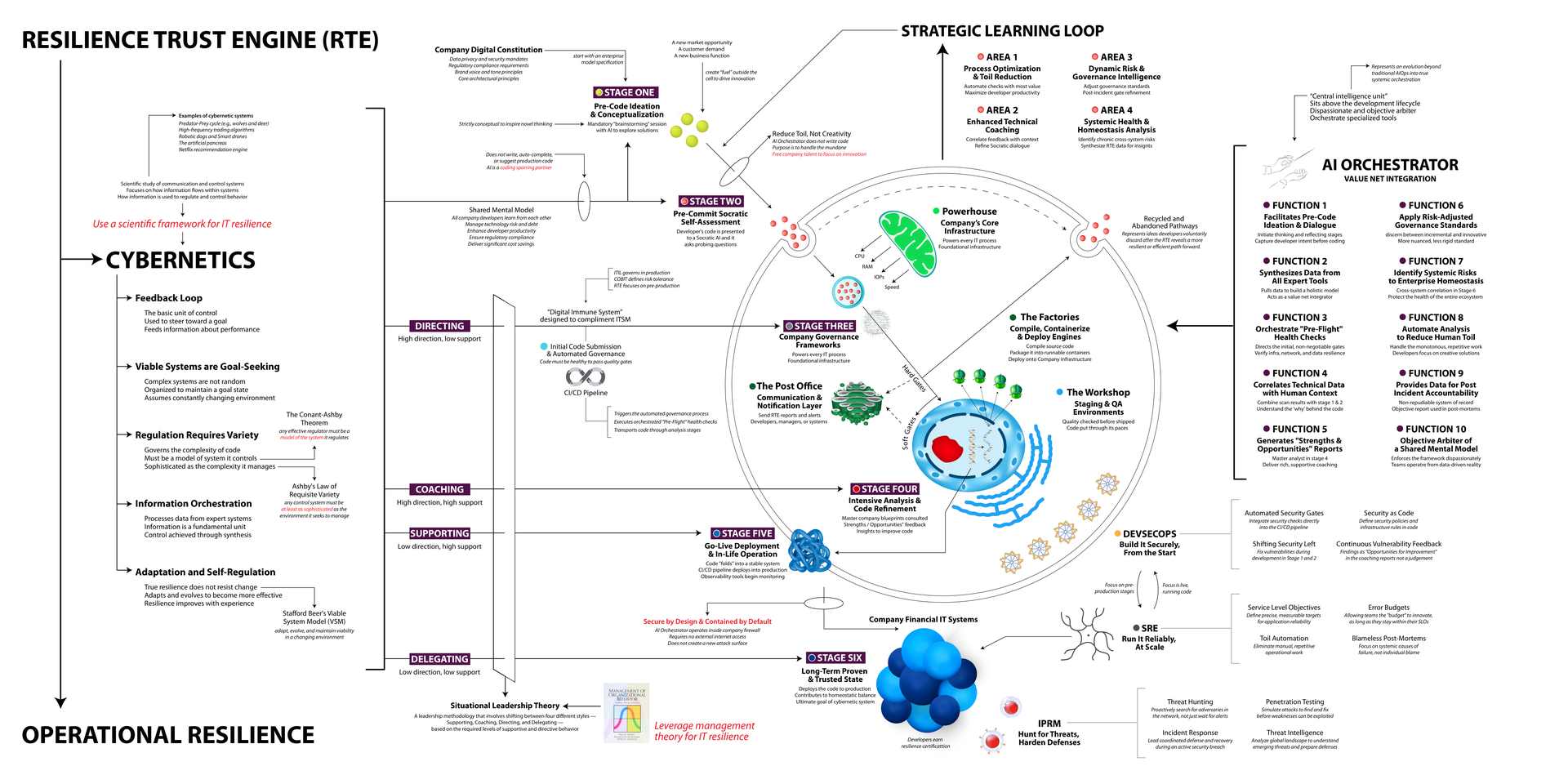
Cybernetic Core Foundations:
The Resilience Trust Engine is anchored in cybernetics, leveraging Stafford Beer's Viable System Model and Ashby's Law of Requisite Variety. By structuring IT operations as goal-seeking, self-regulating feedback loops, organizations can successfully manage complex systems. This scientific foundation ensures the infrastructure adapts dynamically, maintaining homeostasis and operational resilience against inevitable, disruptive environmental challenges.
|
Structured Lifecycle Governance:
Software delivery is transformed through a rigorous six-stage development lifecycle that embeds governance into every phase. Starting with pre-code ideation and Socratic self-assessment, the pipeline advances through automated policy checks, intensive analysis, and secure deployment. This structured progression establishes a strategic learning loop that optimizes processes and continually minimizes critical technical debt.
|
Intelligent AI Orchestration:
The AI Orchestrator serves as a centralized intelligence unit, integrating data across specialized tools to synthesize risks and automate repetitive toil. Operating securely within the corporate firewall, it facilitates collaborative ideation, applies risk-adjusted standards, and acts as an objective arbiter. This cognitive layer fosters a shared mental model, driving robust organizational agility.
|