Mapping the Knowledge Matrix:
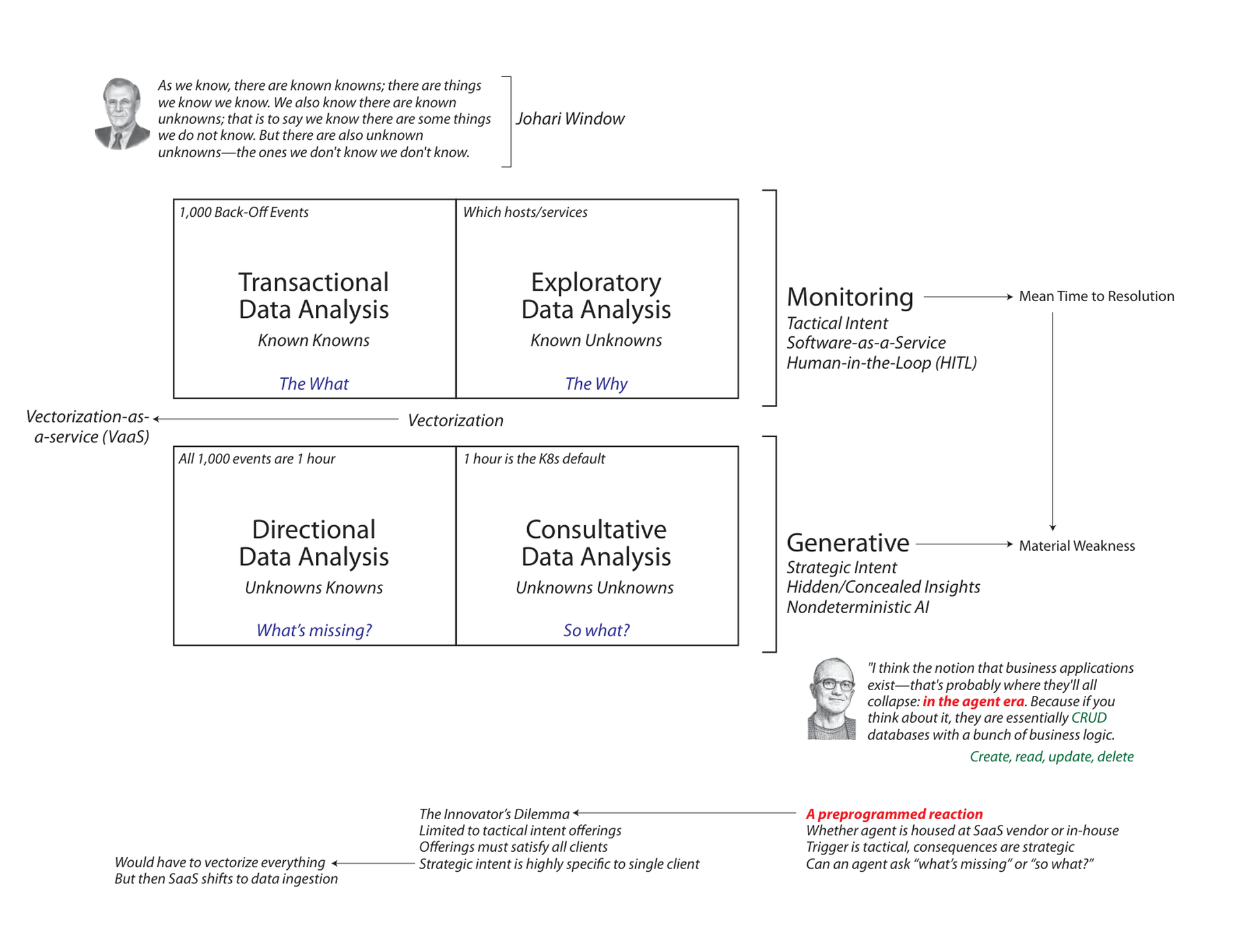
The framework adapts the Johari Window to map data analysis into four strategic quadrants. Transactional and exploratory analyses address known elements to provide tactical monitoring. Meanwhile, directional and consultative analyses explore unknowns, prompting deeper inquiries about missing context and strategic implications. This taxonomy helps enterprises shift from basic diagnostic observation to proactive, strategic decision-making.
|
The Agentic Collapse of CRUD SaaS:
Traditional business applications risk disruption as the industry enters the agentic era. Legacy software, often limited to basic CRUD operations, faces obsolescence against nondeterministic AI. Generative models move beyond simple SaaS monitoring toward strategic intent, uncovering concealed insights that address material weaknesses. This evolution fundamentally redefines the role of software from passive execution to active strategic partnership.
|
Strategic Intent and Vectorization:
Organizations face a strategic bottleneck in scaling tailored AI solutions. While standard SaaS offerings successfully resolve tactical needs for broad customer bases, highly specific strategic intent demands bespoke vectorization. This tension forces a transition toward vectorization-as-a-service. Consequently, SaaS vendors must pivot toward comprehensive data ingestion pipelines to satisfy custom corporate architectures without sacrificing standard product scalability.
|